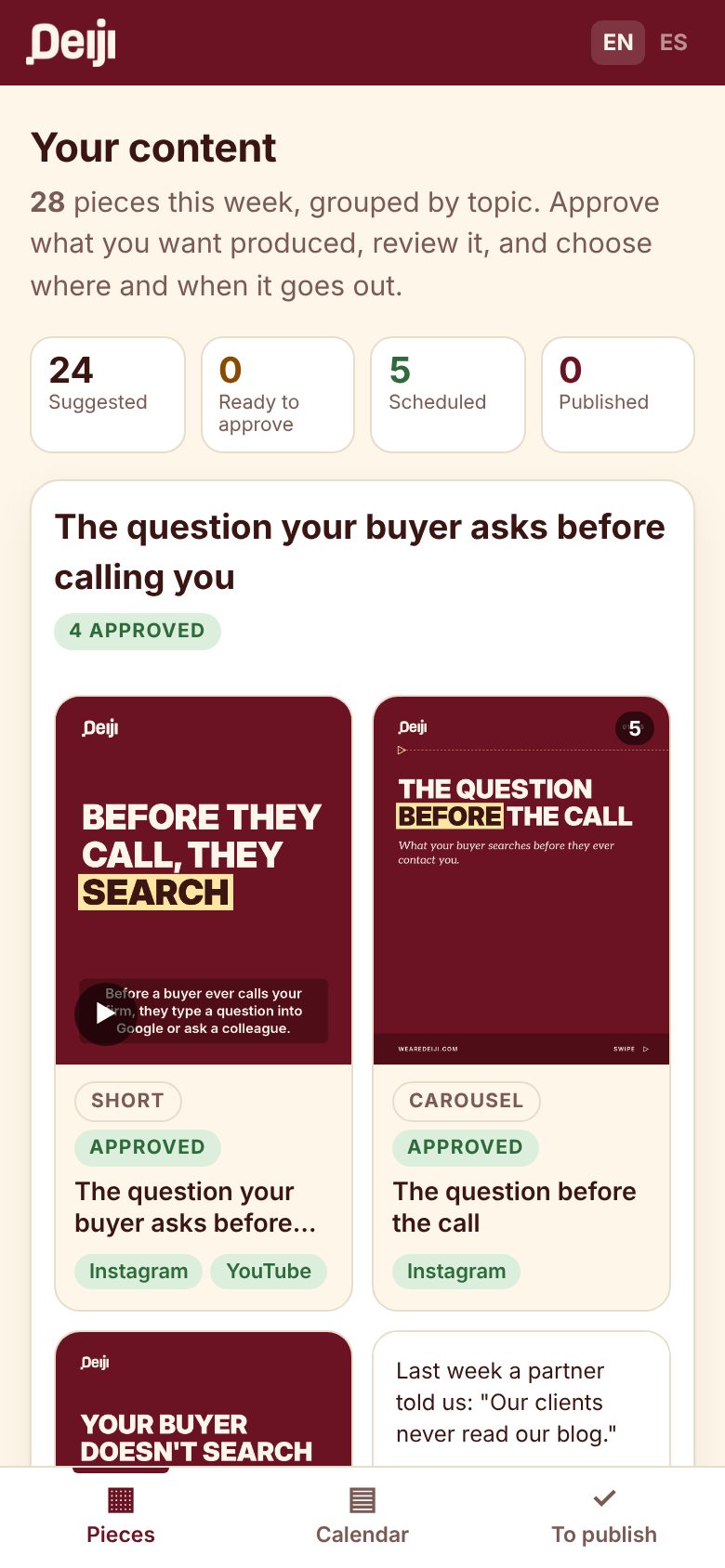
B2B content
Deiji
What a B2B buyer needs to understand before choosing a provider, in daily pieces for LinkedIn and Instagram.
Your buyer doesn't start by looking for a provider. They start with a problem: something that keeps going wrong, costs too much or doesn't add up.
If, while they work it out, they keep finding you, useful and specific, then when they look for someone to solve it, you're the obvious answer. The right person thinks: "They understand my problem."
Your marketing doesn't need to sound bigger. It needs to sound more like you.
Start a conversation Or see the questions your buyers ask firstUngeneric Content Stream
28 pieces a week, one per network per day, said the way you would say them.
Every Friday next week arrives, grouped by topic. You choose what gets made, watch it, edit it if you want, and pick where and when it goes out. The calendar fills up as you approve.
This isn't a mock-up. It's the same system already running on three of our own brands, in fields that have nothing in common. Here is how it looks in each.
B2B content
What a B2B buyer needs to understand before choosing a provider, in daily pieces for LinkedIn and Instagram.
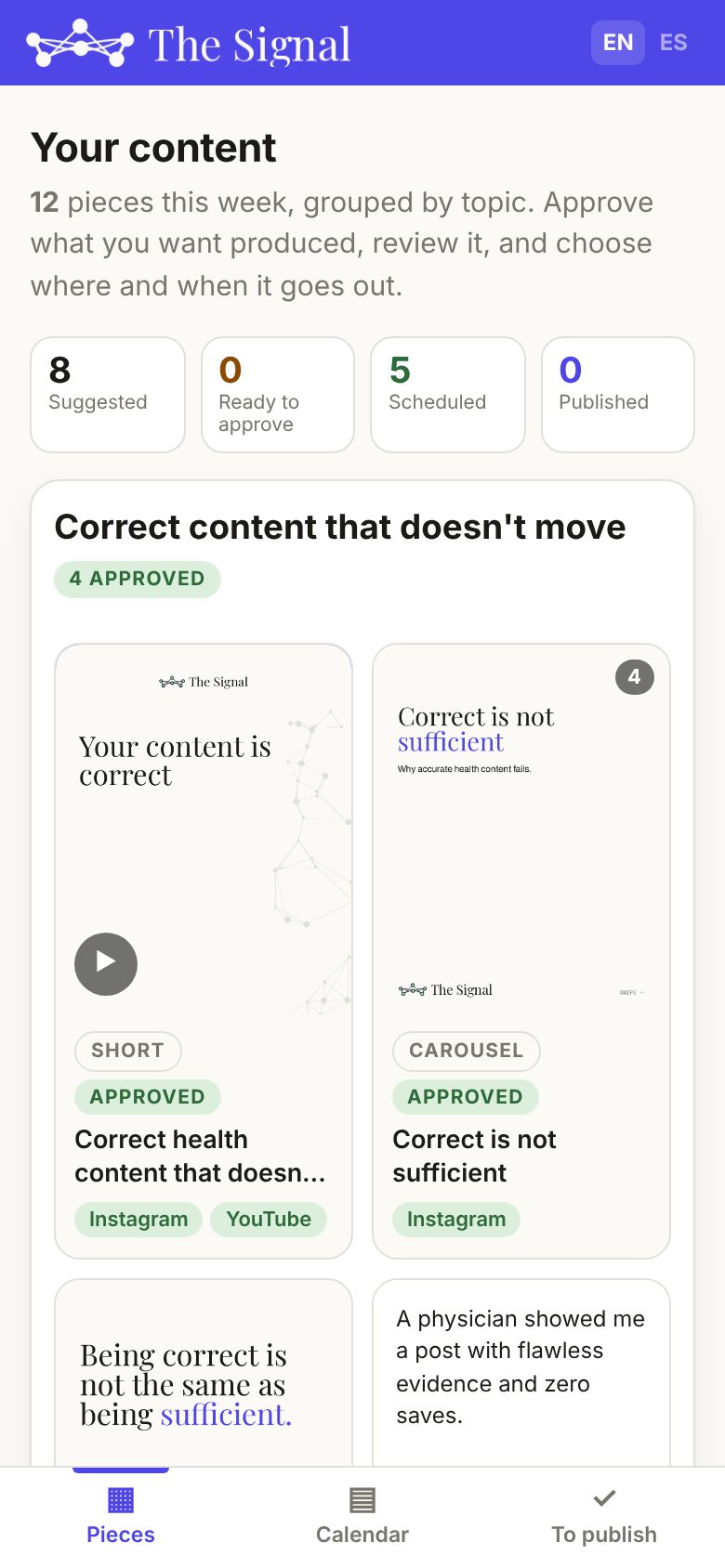
Health creators
Why correct medical content so often fails to travel, told for the physicians who create content.
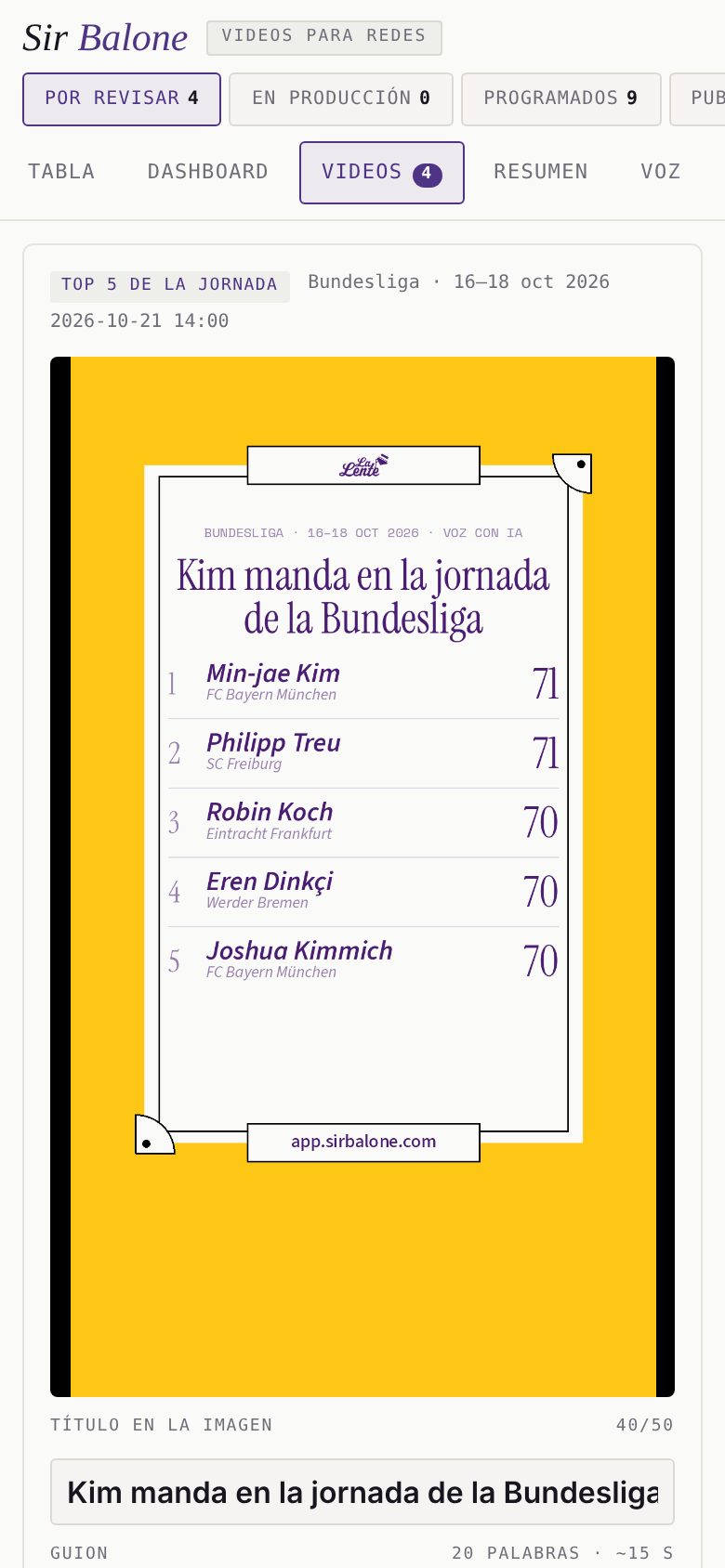
Football
Every matchday in the big leagues, read with its own criteria: rankings, analysis and short videos every day.
Three fields with nothing in common. The same Friday.
Ungeneric Content Engine · a client

Cleaning is easy to market generically. Quality. Reliability. Great service.
Instead of asking "What can a cleaning company post about?", we asked "What does a buyer need to understand when choosing one?"
That opened a different set of questions. Questions about:
The subject was still cleaning. The conversation was not.
One question, one system
The buyer's question
“How do I know my provider is actually doing a good job?”
Where it came from: facilities managers' reviews of cleaning providers, and what local competitors leave unanswered.
What it becomes
What made it theirs J&L's answer to the question. That is the part nobody else can write.
One article answers one question. A body of them, around the same problem, is what makes you the answer. Want to see what this looks like for your company? Tell us your website and market, and we'll email you three questions your buyers ask and what one of them could become.
Get your free diagnosisYou probably already know more than your marketing says.
You don't need a proprietary framework. You don't need to call yourself a thought leader. You just need to have done the work.
Behind every company are people who have seen things, solved problems, made mistakes and helped customers make decisions. That's where good content comes from.
Yet corporate communication strips it all away, and everything starts sounding the same:
Useful enough to fill a content calendar. Not useful enough to be remembered.
Underneath, there's something more interesting
That's the material.
We research, extract, shape and connect what your business knows to what your buyers need to understand.
Most content starts with
What should we post this week?
We start with
What does your buyer need to understand?
Then we look for where that question meets what your company genuinely knows.
Imagine 100 companies in your industry. All of them can publish a list of criteria for choosing a provider. All of them can say they care about quality.
But they haven't seen the same things. They don't notice the same problems. They don't tell the same stories.
Put 50,000 people in a stadium and ask them about the match afterward. You won't get 50,000 identical answers. Companies are no different.
Differentiation doesn't always come from saying something nobody has said. Sometimes it comes from seeing something familiar differently.
That's what we look for.
The content is the visible part. The thinking underneath is what makes it useful.
We research the subject, challenge it and shape a clear point of view. Then we make it travel, because a strong idea shouldn't disappear after one blog post.
The complete argument, deep enough to be useful.
The ideas worth seeing before someone reads the whole thing.
The framework made easy to understand and share.
The idea in motion, without empty soundbites.
Delivered to people who already chose to listen.
Something your team can reference in a real buyer conversation.
One idea. Many buying moments. Not six versions of the same generic content.
We don't just recommend this approach. We run our own brands on it.
Sir Balone and The Signal are projects from our own studio. Two very different subjects, the same starting point: a real question, and something worth saying about it.

Football, curated.
Football content is everywhere: results, rumours, hot takes. Most of it answers "What happened?"
Sir Balone starts somewhere else: What makes football, football? Is it really a contact sport? Should a referee's mistake be part of the game's charm? Does the result never lie?
Those questions became a foundational essay on the identity of the game, analyses that challenge the sport's most repeated narratives, a proprietary player taxonomy and daily short videos built on the same ideas.
Same sport everyone talks about. A conversation almost nobody is having.

Closing the gap between knowing a lot and communicating well.
Doctors who create content have something most health influencers don't: rigor. Yet they keep losing attention to people who sell certainty.
The Signal starts with that question: Why does the most rigorous voice so often lose? The answer became a body of essays and original concepts, like the Assembly Cost readers pay to turn scattered medical content into something usable, and the Rigor Penalty that comes with refusing to oversimplify. Those ideas then became articles, social content and AI tools for healthcare creators.
Same ethical constraints every physician has. A clearer way to compete within them.

Brand & Customer Experience
Margarita has spent her career on the other side of the conversation: brand experience, customer experience, design and digital transformation. She knows what customers actually ask, where they get stuck and what makes them trust a company. That is where every Deiji project begins: with the buyer's real questions.

Growth & Distribution
Mauricio has spent a decade making sure good work actually gets seen. He has run SEO, paid media, websites, ecommerce and marketplaces for brands across Latin America and North America, and coordinated the creative production behind them. At Deiji, he builds the system that takes each idea to the channels, searches and feeds where your buyers are already looking.
One starts from the buyer's questions. The other makes sure what you know reaches them. Together, they turn what your company knows into something your buyers find and remember.
We work with consultancies, professional services, technology and specialized B2B firms. These are companies where buyers research before they decide, and where the people inside know far more than the marketing says.
You don't have to be famous. You don't have to be revolutionary. You just have to have something real to say.
So when the question appears, your company is already part of the answer.
Start a conversation Or see the questions your buyers ask first